There are many kinds of astrology, but that doesn’t mean one of them is more or less “real” than another. Every astrological tradition reflects the era and cultural context that shaped it. So if you’ve ever been confused when one astrologer says Mars is the ruler of Scorpio and another says it’s Pluto, that’s fair. You’re not alone.
This article breaks down everything you need to know about the differences and similarities between traditional and modern astrology — and why they matter.

What we mean by “traditional” and “modern”
At CHANI, everything we do is rooted in traditional astrology, specifically the Hellenistic system established in ancient Mesopotamia, Egypt, and Greece in the 2nd and 1st centuries BCE. What we call modern astrology has emerged over the past two centuries — still relatively young, but just as valid.
In the West, astrology was widely considered a legitimate subject of study, alongside astronomy, until the 17th century CE. But during the Scientific Revolution and the Age of Enlightenment, astronomers rejected the theoretical foundations of astrology, which they viewed as a pseudoscience, and this ancient tradition fell out of favor.
But astrology made a comeback in the West — and modern astrology as we know it was born — in the late 19th and early 20th centuries. One of the driving forces behind this revival was British astrologer Alan Leo, who did something pretty revolutionary: He anchored everything in the Sun sign (i.e., the sign the Sun was passing through when you were born), which he described as a person’s psychological focal point. Leo wanted to rebrand astrology as a tool for self-exploration rather than a predictive art, partly to avoid persecution. By reframing astrology as an indicator of “personal tendencies” and not a forecast of actual future events, Alan Leo hoped to defend himself against charges of “fortune telling,” which was illegal under the Witchcraft Act of 1735. Before this shift, traditional astrology emphasized the ascendant (aka your rising sign), which is more specific to each person because it’s based on the exact time and place of their birth. As a result of Leo’s work, astrology became a bit less precise and technical — but also more accessible.
Different systems of astrology for very different worlds
As modern astrology emerged in the West, it tended to focus more on a person’s inner world — someone’s behavior patterns, their habitual reactions, and the reasons they keep ending up in the same situations. This was also a period when the psychological novel was in vogue, while spiritual movements like Transcendentalism and occult practices like séances, spirit photography, and automatic writing were entering the mainstream. As more and more people sought guidance from a wider range of belief systems and wisdom traditions, astrology flourished once again.
But 2,000 years ago, most people weren’t turning to astrology for self-help or relationship advice. While ancient texts do address how the stars and planets can influence someone’s character or temperament, traditional astrology was originally used for less personal purposes, such as figuring out when to establish a city, begin a sea journey, find a lost object, or go to war.
When Alan Leo was popularizing Sun sign astrology, these traditional approaches were still obscure, but they weren’t dismissed or forgotten. They were just harder for most people to access and understand, since many of the ancient texts weren’t translated into modern languages until later in the 20th century. And the conceptual frameworks of ancient astrology were built so elegantly that they’re timeless.
But what exactly were these traditional tools and techniques? Let’s get into it.
Traditional vs. modern astro techniques
As we explained, ancient astrology tends to be more deterministic and predictive, focusing on fate, divination, life circumstances, and the timing of events, while modern astrology focuses more on free will, personal psychology, and self-development. But these traditions aren’t totally unrelated, and many techniques in modern astrology are rooted in ancient practices. Here’s a breakdown of where these two systems diverge and overlap.
1. Planetary rulers
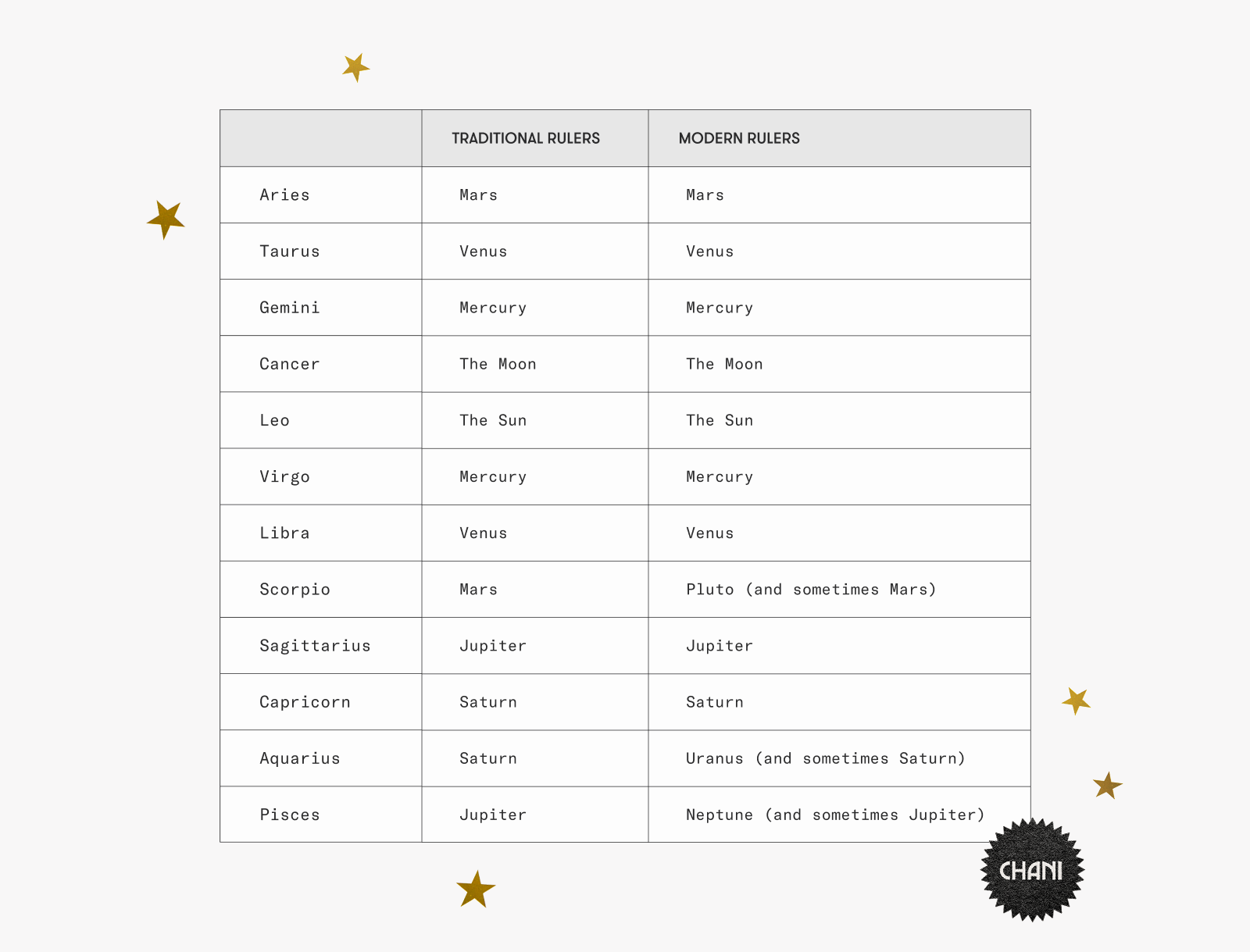
Ancient astrology uses only the seven traditional planets (aka the planets that are visible to the naked eye): the Sun, the Moon, Mercury, Venus, Mars, Jupiter, and Saturn. The ancients imagined the Sun and Moon as the king and queen of the cosmos, and they thought of the two luminaries as the “rulers” of the two signs that align with the brightest days of summer in the Northern Hemisphere, giving Cancer to the Moon and Leo to the Sun. They decided that the five other planets would rule two signs each, going in order of their distance from the Sun, making Mercury the ruler of Gemini and Virgo, Venus of Taurus and Libra, Mars of Aries and Scorpio, Jupiter of Pisces and Sagittarius, and Saturn of Aquarius and Capricorn.
Since the invention of the telescope and the discovery of Uranus, Neptune, and Pluto, modern astrology has brought these celestial bodies into the mix and made them the rulers of certain signs that have similar energies. For example, modern astrologers think of Neptune as the ruler of Pisces because both the planet of dreams and this mutable water sign are concerned with spirituality and imagination.
For traditional astrologers, using modern planets as rulers feels a bit arbitrary. They don’t fit into the internal logic that the ancients carefully mapped out. And modern rulerships have changed how we understand the signs of the zodiac. The ancients didn’t think of Aquarius as “the revolutionary,” for example, but modern astrologers do because they associate this sign with its modern ruler, Uranus (the planet of disruption and rebellion). So now Aquarius isn’t as widely known for its ability to create well-organized systems, which this fixed air sign shares with its traditional ruler, Saturn (the planet of structure). It’s natural for astrological interpretations to shift and evolve, but we risk losing some traditional meanings in the process.
Here are the traditional and modern rulers of each sign:
Reminder: At CHANI, we work with the traditional planetary rulers.
2. Dignity
Just as the seven traditional planets rule specific signs in ancient astrology, each planet has an easier time in some signs and a rougher time in others. This is what the ancients called essential dignity, which is a measure of how supported (or unsupported) a planet is in a given sign. For example, because Mars is the traditional ruler of Aries, the ancients believed that the planet of aggression is at home in this assertive fire sign (aka its domicile sign), meaning it has all the tools and resources it needs in this placement. Meanwhile, Venus is under extra strain in practical Virgo (the sign of its fall), where the planet of love, beauty, and pleasure struggles to do what it does best.
Modern astrologers, by contrast, generally don’t think of any sign placement as better or worse for a planet. We at CHANI are all for being constructive and nonjudgmental, but we also think an important part of understanding astrology is recognizing when a planet is in a tough spot, without sugarcoating what makes it difficult. In traditional astrology, some planets are less comfortable traveling through certain signs, which simply means the planet has to work a little harder to do its job — and it teaches us how to do the same. If you have a planet in fall or detriment in your birth chart, it’s showing you an area of your life where you have to put in more time and effort, so you can be prepared. And learning how to meet these challenges helps you develop more strength and resilience.
3. Aspects
Traditional and modern astrology also take different approaches to aspects (aka the relationships between planets). The ancient mathematician, astronomer, and astrologer Ptolemy defined five major planetary aspects, which form the basis of both traditional and modern astrology: the conjunction, the sextile, the square, the trine, and the opposition. Each of these “Ptolemaic aspects” (aka “traditional major aspects”) refers to a geometric angle between two planets, based on their relative positions in the sky. Harmonious aspects like sextiles and trines tend to feel easier and smoother, while challenging aspects like squares and oppositions can bring friction and tension.
Modern astrologers still use the five Ptolemaic aspects, but they’ve added so-called “minor aspects,” expanding the range of ways two planets can interact. Heard of the “quincunx,” the modern term for a 150º aspect, or maybe the “sesquiquadrate,” meaning a 135º aspect between two planets?
Traditional astrologers don’t use these minor aspects because they believe it’s important to note when planets don’t form any major aspects. Ancient astrologers described this situation as “aversion,” a state of disconnect between planets that can’t witness or perceive one another. (Fun fact: The word “aspect” comes from the Latin verb specere, which means “to look.” So when two planets are in aversion, it’s like they really can’t see each other.) If misunderstandings and mixups keep happening with someone you know, traditional astrologers might ask if your natal Mercury (the planet of communication) is in aversion to that person’s Mercury placement — for example, maybe your Mercury in Virgo can’t “see” their Mercury in Aries. This doesn’t mean the two of you will keep getting lost in translation forever; it just means you’ll have to make a more intentional effort to get on the same page.
In traditional astrology, the idea of aversion is key to understanding both how planets relate to each other and how they struggle to connect. And that gets harder to understand when we try to fill in the gaps with minor aspects.
.png)
Reminder: At CHANI, we only work with major aspects.
4. Houses
Two of the most widely used house systems are Whole Sign Houses and Placidus, which both have roots in traditional astrology (though Placidus was popularized by Placidus de Titis in the 17th century CE). Because many online chart tools default to Placidus, it’s become the go-to for many modern astrologers and newbies looking up their charts for the first time. While some ancient astrologers used Placidus, Whole Sign Houses was the most common system during the Hellenistic period — and partly for that reason, it’s the one we use at CHANI.
In Whole Sign Houses, the sky is divided into 12 equally sized houses of 30º each, and every house in a chart contains an entire sign. So if your ascendant is in Leo, then Leo is in your 1st House, Virgo is in your 2nd House, Libra is in your 3rd House, and so on. This simple, straightforward system supports the larger, more complex philosophical framework of traditional astrology. On the other hand, Placidus divides the sky into 12 unequal houses, based on the time it takes for a planet to travel from the ascendant to the midheaven (aka MC, which refers to the highest point in the sky). Placidus determines the location of each house in your chart based on the time and place of your birth, meaning the 12 houses don’t line up with the 12 signs. So in house systems like Placidus, where the size of each house can vary widely, you might have two planets in the same sign but in different houses — and that can make things harder to interpret at first.
Traditional and modern astrologers also have different views on the topics of the 12 houses. To make things easier to remember, Alan Leo equated the meanings of the 12 houses with the meanings of the 12 signs, going in order from first to last. Thanks to him, modern astrologers tend to conflate the 1st House with the first sign of the zodiac (Aries), the 2nd House with the second sign (Taurus), and so on. This makes some sense, since the qualities of the signs often parallel the houses — for example, Gemini likes to yap, and by coincidence, the 3rd House is about communication. But in traditional astrology, the 3rd House is also the place of neighbors, extended family members, and everyday habits, which we don’t necessarily associate with Gemini. So we miss a lot of these important differences when modern astrologers focus on the overlaps between signs and houses.
Ancient astrologers developed the topics of each house based on how the Sun travels through the sky, from sunrise to sunset and back to sunrise again, and on each house’s relationship to the ascendant. So the 1st House represents life and vitality because it’s the part of the sky on the eastern horizon, where the Sun is “reborn” every morning. And the 8th House is connected to death and transformation because this is where the Sun appears when it starts to set near the end of the day; it’s also a place where the Sun can’t “see” the ascendant through a traditional aspect, so that means the 8th House is in aversion to the 1st House, which is all about being alive. Modern astrologers view the 8th House as the place of “sex, death, and rock and roll,” mainly because they associate these intense experiences with Scorpio, the eighth sign of the zodiac. But in traditional astrology, both sex and music would fall in the 5th House of pleasure and creativity.
The 12 houses were never meant to be counterparts to the 12 signs. In traditional astrology, the houses are a lot more nuanced than that. And those nuances can get erased in modern house systems.
Pick your lens
If what you learn about astrology ever seems inconsistent, now you know why. There isn’t just one system. There are many traditions, and they often overlap — but they were built by different people, for different purposes, and within different contexts.
At CHANI, our work is rooted in traditional astrology because it offers time-tested tools for understanding what’s unfolding in the sky and how to make the most of the astrology here on Earth — as above, so below. All astrologers are looking at the same sky, just through different lenses. The trick is knowing which lens you’re using and what it’s showing you. This isn’t about picking sides or proving which system is “right”; it’s about deciding which approach to astrology works best for you. And once you find one that fits, whether it’s traditional or modern, you’ll be able to navigate your life with much more confidence.