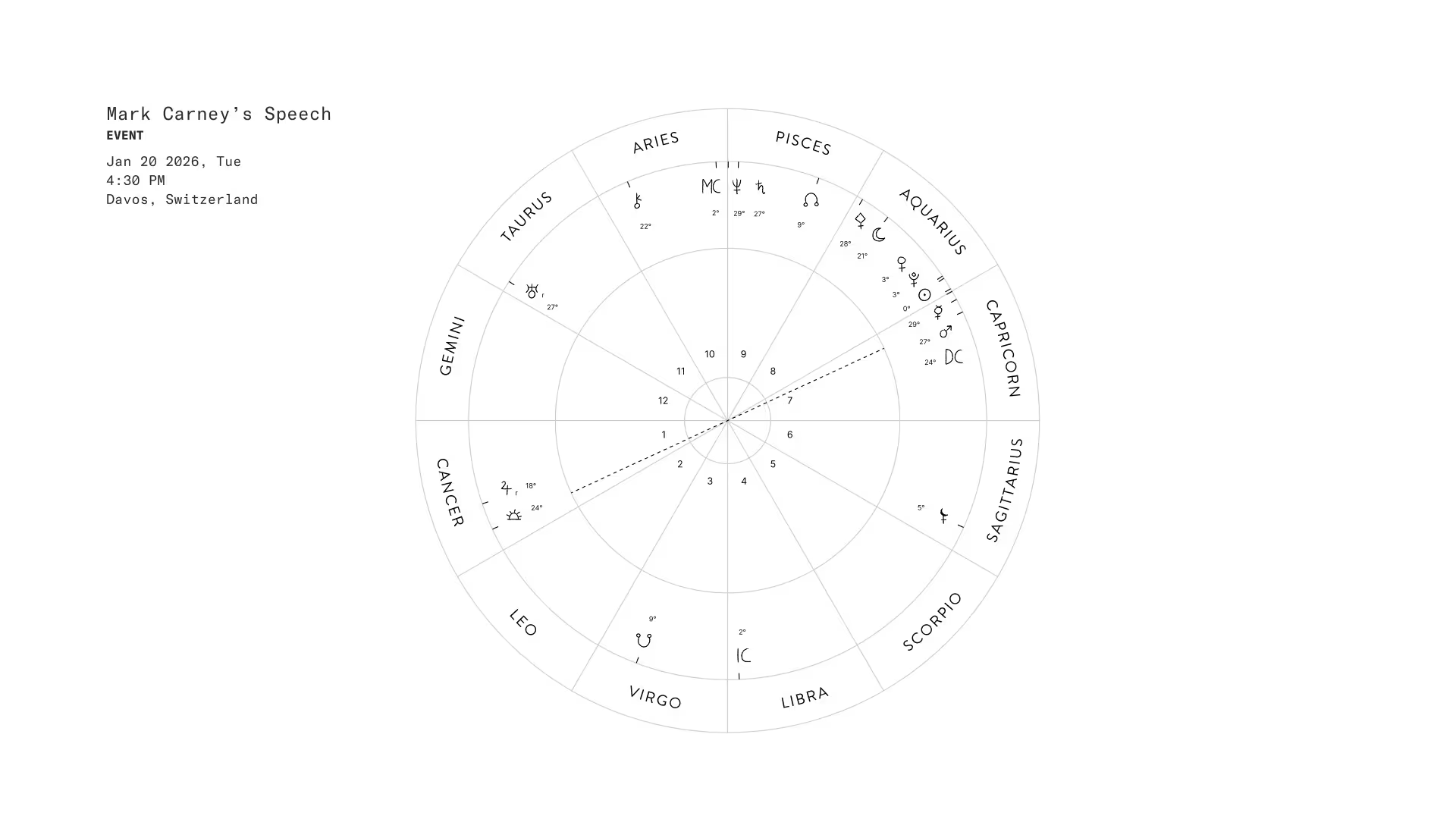
Every now and then, someone puts words to the astrology so literally that I have to text another astrologer to witness how on-the-nose it all is. My latest experience of this was hearing Canadian Prime Minister Mark Carney’s special address at the World Economic Forum meeting in Davos, Switzerland. Carney spoke on January 20th, 2026, the first day of Aquarius season, when Mercury was conjunct the Sun within 40 arc minutes, approaching an exact cazimi. All cazimis are clarifying, but especially Mercury cazimis, because Mercury is the planet of communication. So if someone is going to show up as the message-bearer of the moment, it’s often when the planetary messenger is in the heart of the Sun.
Carney’s speech struck a chord because he did what few world leaders have dared to do in Trump’s second term: He told the truth. He acknowledged in public that the so-called rules-based order is a fiction. That Canada and other countries bought into this fiction because it benefited them at the time. It helped them get richer and more powerful, even if that power was lopsided, as it so often is.
Carney isn’t the first to expose this fiction. Many artists, thinkers, writers, activists, and politicians have called out the world order for what it is: rigged. What’s new is that someone who represents that order — Carney is a liberal, a central banker, and the former governor of both the Bank of Canada and the Bank of England — is the one delivering the eulogy.
In his speech, Carney cited the 1978 essay “The Power of the Powerless” by Václav Havel, the Czech dissident who later became the president of the Czech Republic. Havel’s essay describes a hypothetical grocer displaying a sign that says, “Workers of the world, unite!” That slogan may sound harmless or even hopeful now, but at the time, it was USSR propaganda. The grocer displays this sign not because he believes in the words but because he was told to do it. Because every other grocer keeps such a sign in their window. If they refuse, it might be taken as dissent. They could be punished. At the very least, they could lose their jobs. Havel asks what would happen instead if the sign said, “I, the greengrocer XY, live here and I know what I must do. I behave in the manner expected of me. I can be depended upon and am beyond reproach. I am obedient and therefore I have the right to be left in peace.”
Such a sign would be more honest and more shameful to hang in your window. Most people don’t like to admit, even to themselves, that they are “afraid and therefore unquestioningly obedient.” So they don’t. Meanwhile, our leaders dismantle healthcare, even when it hurts their own voters. They use their billions to pay for a gilded ballroom. They invade sovereign countries for their oil. They say that what’s happening in Gaza isn’t a genocide. They rationalize putting humans in cages. They suggest that Keith Porter Jr. was an active shooter and a threat, not ringing in the New Year. They insist that Renée Good was trying to run over an ICE officer, that Alex Pretti was holding a gun. They learn, in short, to doubt their own eyes and ears and forget their own values. They send ego-stroking texts to the narcissist-in-chief because they know he (the least evolved of Leo risings) lives to be flattered and adored.
Havel explains that the grocer’s loyalty must take the form of a sign that, on the surface, indicates a level of “disinterested conviction.” In other words, he doesn’t really care what the sign says, and that’s the point. When the message doesn’t implicate someone personally — when it doesn’t expose that they’re a coward, but says something like “so-and-so had it coming because they’re a domestic terrorist” — it conceals that they’re just falling into line.
However.
The system’s power doesn’t come from some objective truth, as Carney went on to say in his address, but from everyone’s willingness to act as if it were true. People only have power when others give it to them. If everyone stops taking for granted that one person or state has all the chips on the table, they expose the fragility of that person or state. We might notice that the terrifying face behind the flame and smoke isn’t some great and powerful wizard but a crumpled old man behind a chintzy curtain.
During Carney’s address, Venus (the planet of love and co-operation) was exactly conjunct Pluto (the planet of wealth, power, and the underworld). The Sun was also a few days shy of its annual Pluto cazimi, which was exact on January 23rd — the second Pluto cazimi we’ve had since the lord of the underworld entered Aquarius for the long haul in November 2024. (The first one aligned with King Cheeto’s inauguration in January 2025, by the way.) Astrologer Abū Ma’shar once compared a cazimi to a planet “sitting upon the throne of the king.” It’s the one moment when a planet is strengthened rather than damaged by its closeness to the Sun. But that doesn’t make cazimis lighthearted or lucky. We saw that with the recent Venus, Mars, and Pluto cazimis on January 6th, 9th, and 23rd, respectively, which coincided with Trump’s strike on Venezuela, the massacre of protesters in Iran, and the murders of Renée Good and Alex Pretti. Again, cazimis are clarifying, and they lay reality bare — but no promises about that reality being easy.
Since Pluto first dipped into Aquarius in March 2023, astrologers have been talking about this transit’s promise of a “new world order.” After all, the last time Pluto entered this system-oriented sign was in the era of the French, American, and Haitian Revolutions. But there’s even more emphasis on the word “new,” now that the three other slowest-moving planets have since changed signs: Neptune (the planet of delusion) moved into Aries on January 26th, 2026, Saturn (the planet of rules and order) re-enters the same sign on February 13th, and then Uranus (the planet of disruption) returns to Gemini on April 25th. Because these planets take such a long time to orbit the Sun — Pluto will be in Aquarius for 20 years, Neptune in Aries for 13, Uranus in Gemini for seven, and Saturn in Aries for two — they become fixtures in astrology. Like the furniture you lugged up the stairs and would rather not move again, if you can help it. They provide the backdrop: the systems, institutions, and agreements that run in the background, unnoticed by most, until they start malfunctioning or getting attacked. When the most distant planets first dipped into their new signs between 2023 and 2025, we got a teaser of what redecorating could look like. Now, 2026 is delivering on that new arrangement. Of course, the reality is much less benign.
The last time this many outer planets changed signs within just a few years of each other was the 1980s, when Pluto entered Scorpio in 1983, Neptune entered Capricorn in 1984, and then Saturn and Uranus joined Neptune in 1988. During this period, the Soviet Union began to dissolve, and neoliberalism was on the rise — developments that led to the signing of NAFTA in 1992, the founding of the European Union in 1993, and the expansion of NATO. As all the outer planets once more move into new signs during a condensed period, such alliances are examples of the world order that’s currently breaking down. The United States of America is no longer pretending to be the good guy. Instead of paying lip service to the lie that Western democracies are inherently right or good, the regime has decided that they can and will push their power as far as it can go, no matter who or what they destroy in the process.
One day after Mark Carney’s address in Davos, Donald Trump spoke in the same hall and the same time slot. In his meandering, 90-minute monologue, he described Greenland as a “big piece of ice,” erasing the 57,000 people who live there, 90% of whom are Inuit. Specifically, he described Greenland as a piece of ice “between the United States, Russia, and China.” Because that’s how he sees the world: as Easter eggs to be hunted by the major powers. And because Greenland is in the Western Hemisphere, that’s his territory (he thinks). So Trump threatened Europe with an ultimatum: “You can say yes, and we will be very appreciative. Or you can say no, and we will remember.”
Trump sees himself as the successor and heir apparent to a long history of manifest destiny, the 19th-century belief that white Americans had the god-given right to colonize all of North America. The phrase “manifest destiny” was coined by New York journalist John Louis O’Sullivan in 1845, after the annexation of Texas. At the time, Saturn and Neptune were approaching a rare conjunction in Aquarius, so this moment highlighted how Saturnian structures like lines on a map can be washed away by boundaryless Neptune. Saturn and Neptune join forces every 36 years or so, and the last time they came together was in 1989, when the Berlin Wall came down, and when Canada was in the process of negotiating free trade with the United States. Saturn and Neptune have been within a hair of each other over the past year, so many of the same themes have been resurfacing as we get closer to their exact conjunction on February 20th, 2026. Trump is, at his core, a real estate tycoon, and it’s unclear where the limit of his own manifest destiny lies, if there is one. Greenland, Panama, Canada, Gaza, Mars — he operates like it’s all up for grabs. It may be tempting to dismiss his hyperboles, but right now, America is being run by a maniacal dictator, and he’s shown that he has the power to follow through on his threats. After Trump took out Maduro, a poll indicated that one in three Canadians think the US could take “direct action” to assume control over Canada, and one in five Americans agree.
Everyday citizens, tech CEOs, and world leaders alike have a choice: pander to the false king or stop buying into the lie that obedience ensures protection. They can choose, as Carney said, to “stop invoking a ‘rules-based international order’ as though it still functions as advertised.” To stop waiting for all of this to blow over. To take the sign out of the window and name what’s going on. “We know the old order is not coming back,” Carney said at the end of his speech. “We shouldn't mourn it. Nostalgia is not a strategy.”
On the same day that Carney spoke in Davos, I received a gift in the mail from a dear friend. It was a copy of Starhawk’s Dreaming the Dark, first published in 1982, four years after Havel wrote “The Power of the Powerless” and nine years before the USSR formally dissolved. Dreaming the Dark is a book about power. Starhawk is a witch, and when she speaks of power, she means it in the deepest sense of that word: the “power of the unseen, the power that comes from within, the power of the immanent goddess who lies coiled in the heart of every cell of every living thing, who is the spark of every nerve and the life of every breath.” This is very different from what she describes as “power-over,” which includes violence and domination.
“Power from within,” Starhawk continues, “is the power of the low, the dark, the earth; the power that rises from our blood, and our lives.” She asks, “If we are to survive, the question becomes: how do we overthrow, not those presently in power, but the principle of power-over? How do we shape a society based on the principle of power-from-within?” In other words, our job isn’t to replace the powers-that-be with new leadership that will rule by the same principles and abuses, but to stop trying to assert power over each other in the first place.
This is what is asked of us in 2026. This is what is asked of us by the revolutionary age of Pluto in Aquarius and the next boundary-dissolving union of Saturn and Neptune in Aries. And this is what is made clear every time a planet enters the heart of the Sun. When a planet orbits close to the Sun, we lose sight of it in the sky. The Sun’s rays are so bright that they obscure everything else. But as Starhawk points out, there’s a great deal of power concentrated in the places we can’t see. That’s where seeds germinate. That’s where life grows. And while certain showboats pretend otherwise with their bombastic displays of force, we can choose to combine the power within us with other people’s power, and we can make a greater impact together. That’s organizing work. That’s magic. That’s what happens every time people choose protecting one another over their own comfort. That’s what’s happening in Minnesota and Iran and everywhere in between. That’s the revolution. And that’s what they’re scared of.